
-
Trainingarrow_drop_down
- About Training
-
Internationalarrow_drop_down
- About International
- Produce Safety Alliance Grower Training
- Good Fishing Vessel Practices
- Aquaculture Training Programs
- Good Agricultural Practices
- Commercially Sterile Packaged Foods
- Food Inspector Training
- Supply Chain Management for Spices and Botanical Ingredients
- WTO-SPS Professional Development
- Training Data
-
Collaborationsarrow_drop_down
- About Collaborations
-
International Collaborationsarrow_drop_down
- About International Collaborations
- About Collaborative Training Initiatives
- Collaborative Produce Safety Training Initiative
- Bangladesh Aquatic and Aquacultural Food Safety Center
- IICA-JIFSAN Collaborative Training Initiative for the Americas
- India Supply Chain Management for Spices and Botanical Ingredients (SCMSBI)
- Malaysia Ministry of Health Collaborative Framework on Food Safety Capacity Building
- Thailand Center for Commercially Sterile Packaged Foods
- About
- News & Events
- Training
- Research
-
Collaborations
-
International Collaborations
- About Collaborative Training Initiatives
- Collaborative Produce Safety Training Initiative
- Bangladesh Aquatic and Aquacultural Food Safety Center
- IICA-JIFSAN Collaborative Training Initiative for the Americas
- India Supply Chain Management for Spices and Botanical Ingredients (SCMSBI)
- Malaysia Ministry of Health Collaborative Framework on Food Safety Capacity Building
- Thailand Center for Commercially Sterile Packaged Foods
- Partnerships
-
International Collaborations
- Informatics
March 20, 2026, College Park, MD
Members of the Food Safety Lab at the Joint Institute for Food Safety and Applied Nutrition (JIFSAN), University of Maryland, participated in the Mid-Atlantic Microbiome Meet-up 2026, held on March 20 at the Brendan Iribe Center for Computer Science and Engineering. The symposium, focused on “Engineering and Analytics in Microbiome Research,” brought together researchers working on computational and experimental approaches to study complex microbial systems.
Dr. Magaly Toro presented an oral talk on the spatiotemporal dynamics of microbial communities and antimicrobial resistance (AMR) in the Mapocho River watershed (Chile), highlighting insights gained from integrating metagenomic and quasimetagenomic approaches.
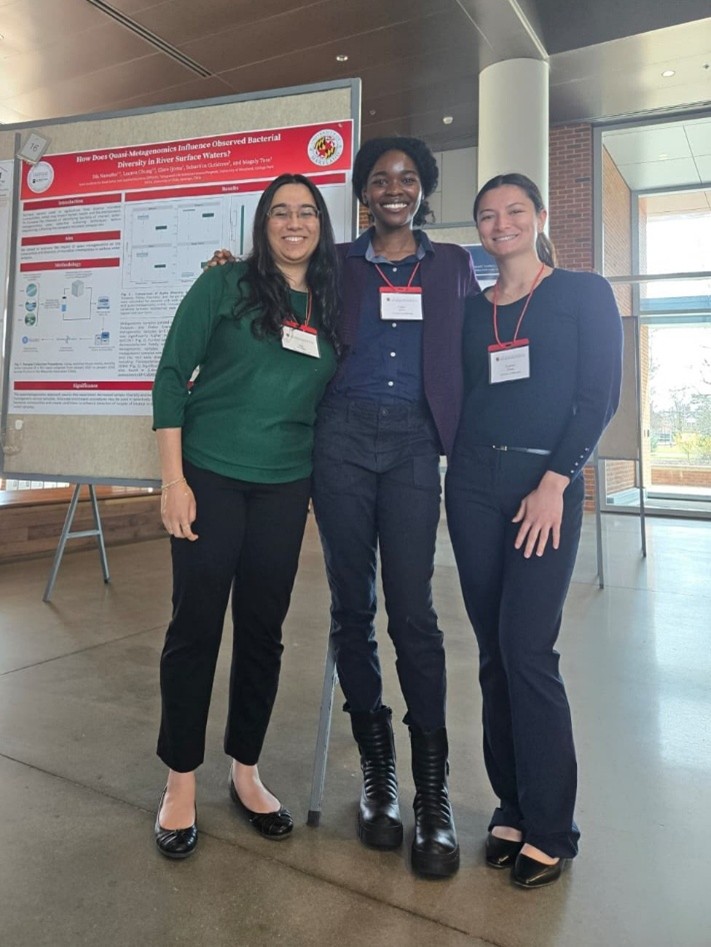
Undergraduate students Clare Ijoma (Public Health) and Dia Nawathe (Computer Science) presented posters examining antimicrobial resistance gene patterns in surface waters and evaluating how quasimetagenomic enrichment influences observed microbial diversity. Lauren Chung, also an undergraduate researcher in the team, contributed as a co-author of the presented abstracts.
These contributions reflect ongoing work in the Food Safety Lab to understand microbial dynamics in aquatic environments and to assess methodological approaches for detecting antimicrobial resistance in complex systems, while supporting undergraduate research training.